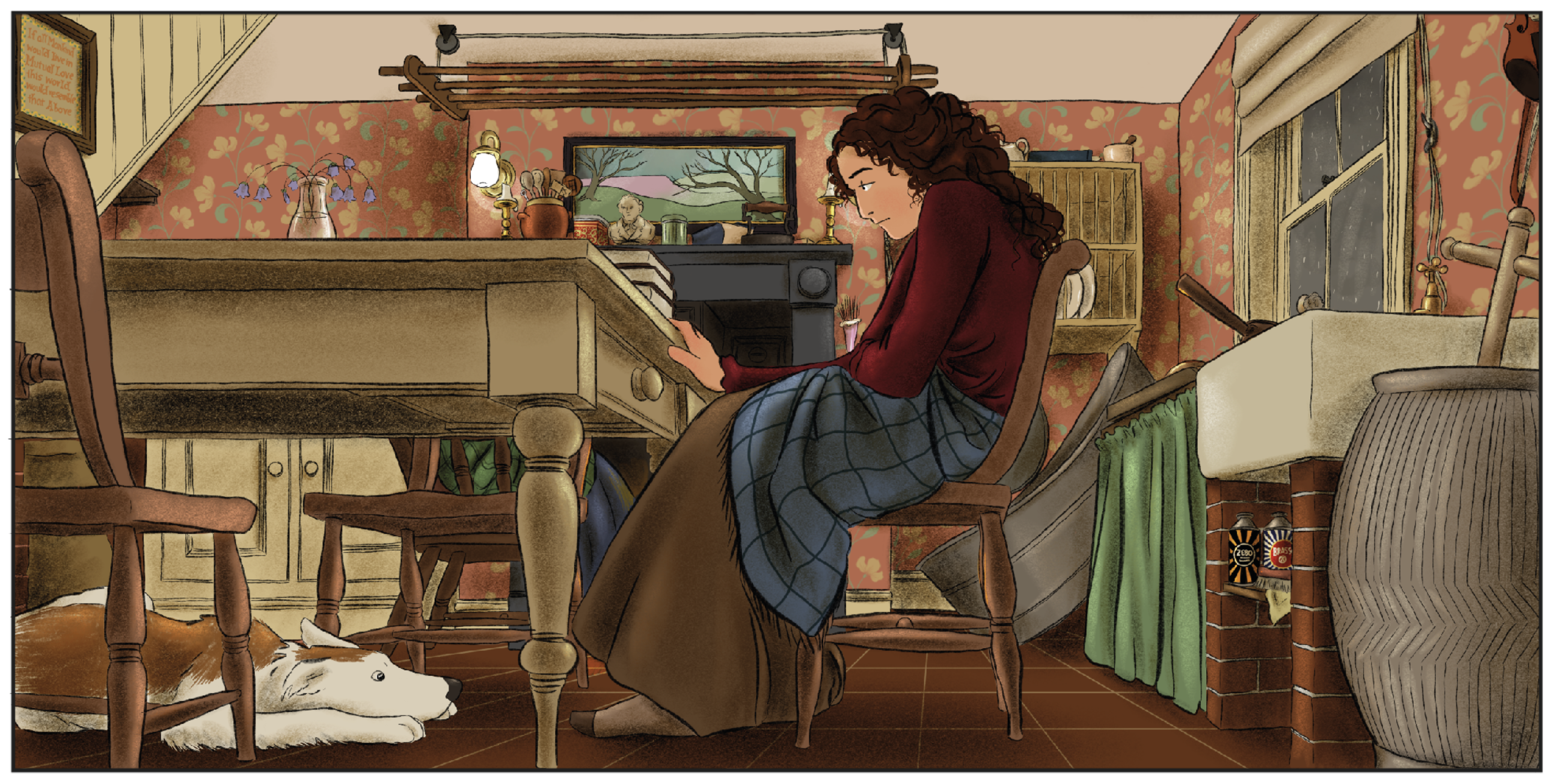
Introducing This Slavery
This Slavery is the dramatic tale of two sisters, and their very different forms of resistance. Set in pre-war industrial Lancashire, the sisters are plunged into crisis when a fire destroys the cotton mill where they work. The whole town falls destitute, and each family does what they must to survive. Rachel is a fighter, an organiser, and a rouser of rabbles. She strives to free her community from the enslavement of the factory just as her stoic sister Hester walks right into another kind of slavery altogether – marriage. Amid this chaos smoulders a love triangle which demands moral principle, courage and fortitude to resolve.
Sophie has adapted the original novel into a script for narrative art, staying faithful to the original whilst making some tweaks to make the most of the medium to tell this important story in the most accessible way possible. We’ve worked together to translate the script into a storyboard that runs to 350+ pages over 18 chapters. Scarlett is now working her way through drawing, colouring and lettering the story with her usual attention to historical detail and warmth of character. Our publisher, SelfMadeHero is expecting the artwork to be submitted this time next year. We’re working with our lovely and encouraging editor David Hine for the third time. This Slavery should be in your hands by autumn 2025. As soon as it’s available to preorder, we’ll let you know. We’re also planning some radical events to celebrate the book and Ethel Carnie Holdsworth around the time of publication.
SelfMadeHero is a specialist graphic novel publisher, and we know they will produce a beautiful book from whatever we send them, to sit neatly on your shelf alongside our last two. This Slavery will be the third in a trilogy of adaptations of Edwardian political novels written ‘from below’ – authentic portrayals of complex struggles c. 1910 in fictionalised form. First, in 2020 we adapted The Ragged Trousered Philanthropists by Robert Tressell. Often considered the working class novel, and used as something of a primer in socialist thought, the novel was always a challenging read. Our graphic version provided a more accessible rendition of this painter and decorator’s analysis of the structural economics of wage labour. Next, in 2022 we adapted No Surrender by Constance Maud. This thrilling novelisation of the factual exploits of the early suffrage movement was used as a recruitment tool in its era, and praised highly by both the WFL and the WSPU. The book’s relevance to modern debates about civil liberties and the ethics of protest, alongside the spectre of reducing reproductive rights continues to alarm us.
And now it’s time for This Slavery, a fiery and angry story that cuts through the intersection between industrialised labour and women’s rights within that system. Although it depicts a very specific element of the industrial revolution – the Lancashire cotton boom of the early 20th century – it has sharp and disturbing relevance to our modern lives. The deregulated gig economy and warehouse workplaces of today are populated by unpaid carers trying to make ends meet. By presenting human beings as something other than economic units and baring some truths about the transactional nature of work, sex and family life, This Slavery holds a mirror to our current economic system. The central themes – about women’s individual ‘freedom’ to choose between the slavery of the factory or the home, and how both underpin the shareholder profits of capitalism – feel just as revolutionary and under-examined today. Ethel constructed radical character dynamics too, presenting police and domestic servants as class-traitors to be mocked, while portraying ‘fallen women’ as redeemable figures of honour, power and respect. By folding all of this into the popular mill-girl fiction of her era, Ethel subverted the genre to offer something new for readers who were her economic peers. This proved unpopular with the Blackburn establishment press, who objected to the book’s unflinching portrayal of harsh living conditions, but also with the left-wing press and political reviewers who considered the book ‘a wasted opportunity’ for its focus on an individual romance. But she wasn’t writing it for them, was she?
Ethel was an incredibly successful popular novelist as well as journalist and poet. She wrote ten novels, one of which outsold HG Wells and was made into a film! This is quite remarkable for a person who began working life aged 11, half-time in a weaving mill and who was putting in 10 hour days as a winder by 13. But the whole time she was devouring all the books made available to her by the local co-operative lending library, reading all night and even trying to read at work without getting caught. Her poetry was published in the Blackburn newspaper when she was 18 and her first poetry collection gained national recognition when she was 21. This booklet saw her ‘rescued’ from the factory and taken to London to write full-time, working on the Clarion and Woman Worker, but the adventure didn’t last long. She was soon back in Lancashire, back at her winding machine.
Ethel’s first novel was published in 1913, and she worked for a time at a Marxist Women’s college in London, where she established the Rebel Pen Club, a literary group for working women. Back up north, she married a local poet Alfred Holdsworth in 1915 and gave birth to a daughter the following year. Alfred was called up in 1917 and later assumed dead, but in fact he survived the war in a prison camp, and their second daughter was born in 1920, amid the peak of Ethel’s literary success. Although we’re almost certain This Slavery had been written before or during the war, it first appeared serialised in 1923 and 1924, but was rejected by the publisher of her popular romance novels. The book was eventually published by a Labour press in 1925, into the swelling industrial tensions building up into the plot-relevant General Strike of 1926. During this time Alfred and Ethel had been pouring their hard-earned wealth and energy into producing and editing The Clear Light, an anti-fascist, anti-militarist, pro-communism, pro-anarchism, pro-labour periodical. She stopped writing altogether in the 1930s, reportedly depressed and worn out by the looming prospect of the second war. Ethel died in Manchester age 76, a largely forgotten literary and political hero.
100 years after first publication, our graphic novel adaptation of This Slavery will become part of a growing revival of Ethel Carnie Holdsworth’s literary reputation. We are grateful to SelfMadeHero, the Arts Council and the Pendle Radicals for the support we have already received, as well as encouragement from Ethel’s living relatives. If you’d like to help keep our noses to the drawing-board, here are some things you can do:
-
buy our books! either from real-life high-street bookshops or from our website
-
talk about our books! in real life, on social media, or on review sites so more people can discover they exist
-
give each other lovely gifts! share the joy of resistance with mugs and tea towels from our collection
We are working to create accessible opportunities for political education as well as entertaining and aesthetically pleasing books, so if you know someone who might enjoy pictures telling a few thousand words about structural economics, civil rights and human resistance, you know what to do. Follow us on Instagram, Twitter, TikTok or Bluesky to watch the unfolding creation of this graphic novel, from concept to publication; or subscribe to our free Substack to stay in the loop.
our next graphic novel